

In the sewage treatment industry, sludge disposal has always been a dual challenge of environmental protection and cost control. Although traditional agents (such as lime, polyacrylamide, etc.) can achieve basic dehydration, they have problems such as persistently high moisture content, severe equipment corrosion, and high risks of secondary pollution. With the upgrading of environmental protection standards, deep dewatering of sludge (moisture content <60%) has become an essential need in the industry. Against this backdrop, the sludge enhancer , with its high efficiency, environmental friendliness and economy, has become the core solution to replace traditional agents, opening up a new path for the resource utilization of sludge.
I. The Predicament of Traditional Pharmaceuticals: The Triple Challenges of Efficiency, Cost and Environmental Protection
Youdaoplaceholder0 dehydration efficiency bottleneck
Traditional agents, through flocculation or chemical precipitation, can only reduce the moisture content of sludge to around 80%, which is difficult to meet the environmental protection requirements for landfill, incineration or resource utilization. For instance, a large amount of polyaluminium chloride needs to be added (the dosage reaches 7% to 20% of the dry weight of the sludge), which leads to an increase in treatment costs. Although lime can reduce the moisture content, it will increase the volume of sludge (by 30% to 50%), and the residue will affect subsequent disposal.
Youdaoplaceholder0 equipment and operating costs are high
Traditional chemicals are highly corrosive to equipment, requiring frequent replacement of filter cloths and filter press components. Taking a certain municipal sewage treatment plant as an example, after the application of lime conditioning, the frequency of filter cloth replacement increased from once every quarter to twice a month, and the annual maintenance cost rose by more than 200,000 yuan. In addition, the residue of chemicals leads to a decrease in the calorific value of sludge, increasing the energy consumption for incineration by 15% to 20%.
Youdaoplaceholder0 risk of secondary pollution
High-molecular flocculants such as polyacrylamide may release harmful substances, affecting the safety of sludge resource utilization products. The alkaline wastewater (pH>12) produced by lime conditioning requires additional neutralization treatment, increasing the complexity of the process.
Ii. Sludge Efficiency Enhancer: Technological Breakthroughs and Core Advantages
Youdaoplaceholder0 deep dehydration mechanism
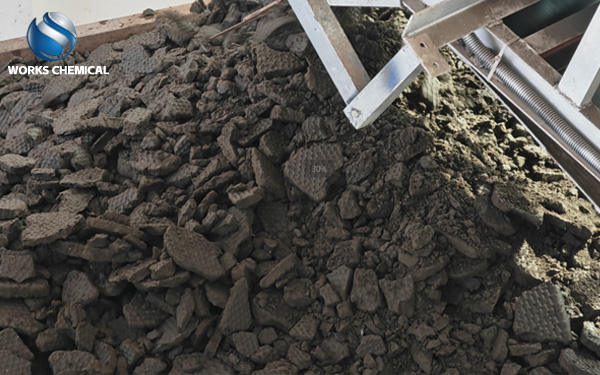
The sludge enhancer reduces the sludge moisture content from over 90% to 40%-60% through the synergistic action of multiple targets. Its core components include:
Youdaoplaceholder0 Inorganic compounds and surface modifiers : Penetrate into the interior of sludge colloids, break down the double electric layer structure of colloids, and cause sludge particles to lose their repulsive force;
Youdaoplaceholder0 cell wall disruptor and degreaser : decomposes extracellular polymers (EPS) and lipid substances, significantly reducing sludge viscosity (experiments show a 60% decrease in viscosity);
Youdaoplaceholder0 Sludge stripping agent : Promotes the separation of sludge and water, ensures smooth water permeability, and reduces the clogging of filter cloth.
Youdaoplaceholder0 economy and environmental protection win-win
Youdaoplaceholder0 Low cost of chemicals : The dosage is only 0.5%-2% of the dry sludge volume, and the treatment cost per ton of sludge is as low as 5-15 yuan, saving 30%-50% compared with traditional chemicals.
Youdaoplaceholder0 Low equipment wear and tear : Free of chloride ions, it does not corrode the filter plates and cloths of the filter press, and its service life is extended by 2-3 times.
Youdaoplaceholder0 resource-friendly : The calorific value of the mud cake increases by 15% to 20%, and it can be directly used as fuel, reducing carbon emissions. The leaching rate of heavy metals complies with the GB/T 23485 standard, and the resource utilization rate reaches 90%.
Youdaoplaceholder0 process adaptability is strong
The sludge enhancer can be used in combination with various equipment such as plate and frame filter presses, screw presses, and belt filter presses. It has strong adaptability to sludge sources (municipal, papermaking, printing and dyeing, chemical, etc.) and pH values (4-10), and does not require complex pretreatment.
Iii. Differentiated Services: Technical support and full-cycle guarantee
Youdaoplaceholder0 Free sampling and customized solutions
We offer free sludge sampling and analysis, and customize enhancer formulas based on sludge properties (such as organic matter content and heavy metal types) to ensure the best dewatering effect.
Youdaoplaceholder0 after-sales tracking and optimization
The team regularly visits customers to monitor the dehydration effect and equipment operation status, dynamically adjusts the dosage of chemicals and process parameters, and ensures long-term stable operation.
Youdaoplaceholder0 technical consultation and training
Provide operation training for customers, guide the setting of key parameters such as pressure control and feeding speed of the filter press, and enhance customers' independent operation and maintenance capabilities.
Sludge enhancers, with their advantages of high efficiency, environmental friendliness and economy, are gradually replacing traditional agents and becoming the core solution for deep sludge dewatering. Its application not only solves the "last mile" problem of sludge disposal, but also provides a key technical guarantee for the transformation of the sewage treatment industry towards green and low-carbon.