

In the daily operation of sewage treatment plants, sludge dewatering treatment is a crucial and highly challenging link. Excessive moisture content in sludge not only increases the difficulty and cost of subsequent treatment and disposal, but also may cause potential harm to the environment. The emergence of sludge enhancers has provided an effective solution for improving the dewatering performance of sludge and plays a key role in the sludge dewatering treatment of sewage treatment plants.
The Current Situation and Challenges of Sludge Dewatering treatment
During the operation of sewage treatment plants, a large amount of sludge is produced, which is characterized by high water content, large volume and rich organic matter content. Traditional sludge dewatering methods, such as natural drying and mechanical dewatering, often encounter numerous problems during the treatment process. Natural drying has a long cycle, occupies a large area, and is greatly affected by climatic conditions. Although mechanical dewatering is relatively efficient, it is difficult to reduce the moisture content of sludge to the ideal level solely by mechanical force. Usually, chemicals need to be added to improve the dewatering performance of sludge. However, traditional chemicals have problems such as unstable effects, large dosage and high cost during use, which are difficult to meet the requirements of modern sewage treatment plants for sludge dewatering treatment.
The working principle of sludge enhancers
Sludge enhancer is a chemical agent specially developed for sludge dewatering treatment. Its working principle is mainly based on the following aspects:
Charge neutralization
The surface of sludge particles usually carries a negative charge, and the particles are dispersed from each other due to electrostatic repulsion, making it difficult for the sludge to coagulate and dewater. The cationic groups in the sludge efficiency agent can neutralize the negative charges on the surface of sludge particles, reducing the electrostatic repulsion between sludge particles, making it easier for sludge particles to aggregate together and form larger flocs, thereby improving the dewatering performance of sludge.
Bridging function
The molecules of sludge enhancers have a long chain structure. The active groups on their molecular chains can simultaneously adsorb multiple sludge particles, forming bridge connections between the sludge particles and linking the dispersed sludge particles into larger flocs. This bridging effect can increase the size and strength of sludge flocs, improve the settling performance and dewatering efficiency of sludge.
The function of net capture and sweeping
When the addition amount of sludge enhancer reaches a certain concentration, its molecular chains will entangle with each other to form a network structure. During the stirring or sedimentation process, these reticular structures can act like sieves to capture and sweep sludge particles, causing them to rapidly aggregate and settle down, further improving the dewatering performance of the sludge.
The application advantages of sludge enhancers in sewage treatment plants
Improve dehydration efficiency
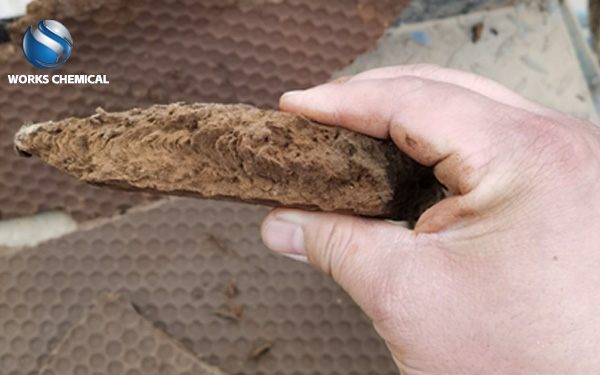
The use of sludge enhancers can significantly enhance the dewatering efficiency of sludge and reduce its moisture content. Under the same dewatering equipment and process conditions, after adding the sludge efficiency enhancer, the dewatering speed of the sludge is accelerated, and the moisture content of the dewatered sludge cake is significantly reduced. For instance, when a certain sewage treatment plant was not using sludge enhancers, it adopted plate and frame filter presses for sludge dewatering. The moisture content of the dewatered sludge cake was approximately 80%. After using the sludge enhancer, the moisture content of the sludge cake can be reduced to below 60%, significantly reducing the volume of sludge and lowering the cost of subsequent treatment and disposal.
Reduce the cost of pharmaceuticals
Compared with traditional sludge dewatering agents, sludge enhancers have the characteristic of small dosage. Due to its remarkable effect, when achieving the same dewatering effect, the dosage of sludge enhancer is usually only a fraction or even a fraction of that of traditional agents. This not only reduces the cost of using the chemicals but also minimizes their pollution to the environment.
Improve the properties of sludge
Sludge enhancers can improve the physical and chemical properties of sludge, making it easier to handle and dispose of. The sludge treated with the sludge enhancer has a more compact floc structure and higher strength. It is less likely to break or scatter during transportation and storage, reducing the risk of secondary pollution. Meanwhile, the stability of sludge has also been enhanced, which is conducive to the subsequent resource utilization of sludge.
Strong adaptability
Sludge enhancers have good adaptability to different types of sludge. Whether it is the excess sludge from urban sewage treatment plants, the sludge produced from industrial wastewater treatment, or other special sludges, the ideal dewatering effect can be achieved by adjusting the model and dosage of the sludge enhancer. This makes sludge enhancers have broad application prospects in various sewage treatment scenarios.
Sludge enhancer, as a new type of sludge dewatering treatment agent, is playing an increasingly important role in the sludge dewatering treatment of sewage treatment plants due to its unique working principle and significant application advantages. It can not only enhance the dewatering efficiency of sludge, reduce the moisture content of sludge, lower the cost of chemicals and environmental pollution, but also improve the properties of sludge, creating favorable conditions for the resource utilization of sludge. With the continuous improvement of environmental protection requirements and the continuous progress of sewage treatment technology, the application prospects of sludge enhancers will be even broader. Sewage treatment plants should, based on their own actual conditions, select appropriate sludge enhancers and optimize their application processes to achieve the goals of efficient, economical and environmentally friendly sludge dewatering treatment.