

In the process of sewage treatment, plate and frame filter presses are commonly used sludge dewatering equipment. However, many sewage treatment plants have encountered a thorny problem - the moisture content of the sludge treated by the plate and frame filter press remains high. This not only increases the difficulty and cost of subsequent sludge treatment, but also poses a potential threat to the environment. So, what exactly causes the high moisture content and how can it be solved? Today, let's talk about this topic and recommend a new type of sludge dewatering agent to you all - sludge enhancer.
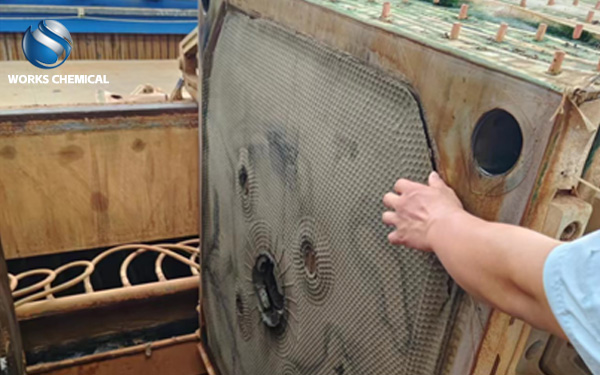
The reasons for high moisture content in sludge dewatering by plate and frame filter press
The issue of sludge properties
The properties of different types of sludge vary greatly. For instance, organic sludge contains a large amount of microorganisms and organic matter, which have strong hydrophilicity and can hinder the removal of water. Moreover, the size and shape of sludge particles can also affect the dewatering effect. If the sludge particles are too fine, they are prone to clogging the filter cloth, preventing water from being discharged smoothly and thus increasing the moisture content.
Equipment and operational factors
The performance and operation mode of the plate and frame filter press itself also have a significant impact on the dewatering effect. If the quality of the filter cloth is poor, it is prone to damage or clogging, which will affect the filtration of water. In addition, if the pressure and time Settings of the filter press are not reasonable, it will also lead to insufficient dewatering.
The pressure is too low, and the water cannot be fully squeezed out. Excessive pressure may also damage the filter cloth and equipment. Moreover, during the filtration process, if the sludge residue on the filter plates and filter cloths is not cleaned in time, it will also reduce the dewatering efficiency and cause the moisture content to rise.
Improper use of the medicine
During the sludge dewatering process, some chemicals are usually added to improve the dewatering performance of the sludge. However, if the selection of the agent is inappropriate or the dosage is inaccurate, the expected effect may not be achieved. For instance, some agents have poor flocculation effects on sludge and are unable to effectively aggregate sludge particles together, making it difficult to remove water. Some agents may also react with certain components in the sludge, generating substances that are not conducive to dewatering and further increasing the moisture content.
The magical effect of sludge enhancers
Facing the problem of high moisture content in sludge dewatering by plate and frame filter presses, sludge enhancers are undoubtedly an excellent solution. It is like a "magician", capable of fundamentally improving the dewatering performance of sludge and reducing its moisture content.
Enhance the flocculation effect of sludge
The sludge enhancer contains special flocculation components, which can quickly combine with sludge particles, gathering fine sludge particles together to form larger flocs. These flocs have excellent sedimentation and dewatering properties, and can be more easily retained by the filter cloth, thus enabling water to be discharged more quickly. Compared with traditional flocculants, the sludge enhancer has a more significant flocculation effect and can achieve rapid sludge dewatering in a shorter time.
Improve the dewatering performance of sludge
Sludge enhancers can also alter the physical and chemical properties of sludge, making it easier to dewater. It can reduce the viscosity and elasticity of sludge, decrease the friction between sludge and filter cloth, and enable water to pass through the filter cloth more smoothly. Meanwhile, the sludge enhancer can also adjust the pH value of the sludge, creating an environment conducive to dewatering and further enhancing the dewatering efficiency.
Reduce costs and increase efficiency
The use of sludge enhancers can not only reduce the moisture content of sludge, but also decrease the dosage of chemicals and the energy consumption of equipment. Due to the excellent flocculation effect of the sludge enhancer, the dosage is relatively small, thereby reducing the cost of the agent. Moreover, the moisture content of the sludge after dewatering is reduced and its volume is decreased, which lowers the transportation and disposal costs of the sludge. In addition, the improvement of dehydration efficiency can also shorten the filtration time, reduce the operating cost of equipment, and enhance the overall benefits of the sewage treatment plant.
High moisture content in sludge dewatering by plate and frame filter presses is a common but headache-inducing problem. However, as long as we identify the root cause of the problem and take effective measures to solve it, we can deal with it easily. Sludge enhancer, as a new type of sludge dewatering additive, has many advantages such as enhancing flocculation effect, improving dewatering performance and reducing cost. If the sewage treatment plant you are in is also troubled by the high moisture content of sludge dewatering, you might as well try the sludge efficiency enhancer. We believe it will bring you unexpected surprises.