

In the field of sewage treatment, sludge treatment has always been a thorny issue, among which the excessively high moisture content of sludge has been a headache for many sewage treatment plants. The emergence of sludge enhancers has brought new hope to solving this problem. They can help achieve deep dewatering of sludge and effectively reduce the moisture content of sludge.
The current situation and challenges of high moisture content in sludge
The sludge produced during the sewage treatment process often has a high water content. Sludge with high moisture content not only has a large volume, occupies a lot of storage space and increases transportation costs, but also greatly increases the difficulty of subsequent treatment. For instance, during landfill treatment, sludge with a high water content is prone to generating leachate, which can cause pollution to the soil and groundwater. If incineration treatment is adopted, the high moisture content will lead to excessive energy consumption during the incineration process, and may even affect the stability of incineration due to the rapid evaporation of water. Therefore, reducing the moisture content of sludge has become a key link in sludge treatment.
The working principle of sludge enhancers
The reason why sludge enhancers can achieve deep dewatering of sludge and reduce its moisture content mainly lies in their unique chemical effects. It can change the charge nature and distribution on the surface of sludge particles, destroy the original colloidal structure of sludge, reduce the repulsive force between sludge particles and enhance the cohesive force. In this way, sludge particles are more likely to aggregate together and form larger flocs. Meanwhile, the sludge enhancer can also form a hydrophobic film on the surface of sludge particles, reducing the binding force between water and sludge particles and promoting the separation of water from the sludge.
Remarkable achievements in practical applications
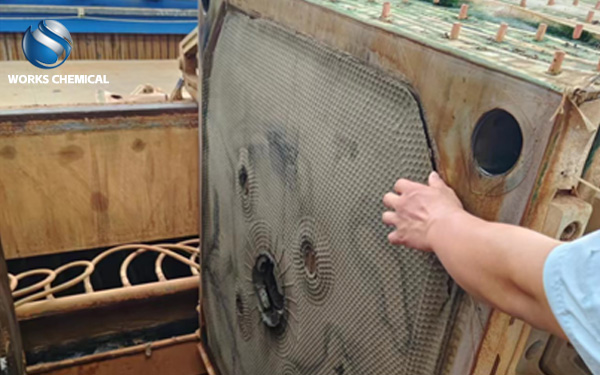
In the actual application of sewage treatment plants, sludge enhancers have demonstrated outstanding dewatering effects. Take a large-scale sewage treatment plant as an example. Before the use of sludge enhancers, the moisture content of the sludge in this plant had long been maintained at around 85%. After being treated by plate and frame filter presses, the moisture content could only be reduced to 75% - 80%. The volume of the treated sludge was still relatively large, and the transportation and disposal costs remained high. However, the situation changed significantly after the introduction of the sludge enhancer. Under the same treatment process and equipment conditions, the moisture content of sludge drops rapidly after the use of sludge enhancers. After being treated by a plate and frame filter press, the moisture content can be reduced to below 60%. This not only significantly reduces the volume of sludge and lowers transportation costs, but also provides more favorable conditions for subsequent sludge disposal. For instance, during landfill treatment, due to the reduction in sludge volume, the required landfill site also decreases accordingly. When undergoing incineration treatment, sludge with a low moisture content burns more thoroughly, consumes less energy, and simultaneously reduces pollutant emissions.
The dual benefits of environmental protection and economy
From an environmental protection perspective, the use of sludge enhancers helps reduce the pollution of sludge to the environment. By reducing the moisture content of sludge, the volume and weight of sludge are decreased, and the impact of sludge on the environment during transportation and disposal is reduced. Meanwhile, when sludge with a low moisture content is incinerated, it can burn more thoroughly, reducing the production of harmful substances such as dioxins and being conducive to protecting the atmospheric environment. From an economic perspective, the application of sludge enhancers can significantly reduce the operating costs of sewage treatment plants. On the one hand, it reduces the volume and weight of sludge, lowering transportation costs; On the other hand, it has enhanced the efficiency of sludge treatment, reduced the usage time and energy consumption of equipment, and lowered the maintenance costs of equipment. In addition, the resource utilization value of sludge after deep dewatering treatment has also been enhanced. For instance, it can be used as building materials, soil conditioners, etc., further increasing economic benefits.
Sludge enhancers, with their unique working principle and remarkable application effects, play a significant role in achieving deep dewatering of sludge and reducing the moisture content of sludge. It not only solves the problem of sludge treatment for sewage treatment plants, bringing dual benefits of environmental protection and economy, but also makes positive contributions to promoting the sustainable development of the sewage treatment industry.