

In the field of sewage treatment, filter presses are common sludge dewatering equipment, but problems such as the sludge not being dried and sticking to the filter cloth occur frequently, seriously affecting the dewatering efficiency and effect. As a new type of chemical agent, can sludge efficiency enhancer effectively solve these problems? The following is a detailed analysis to explore.
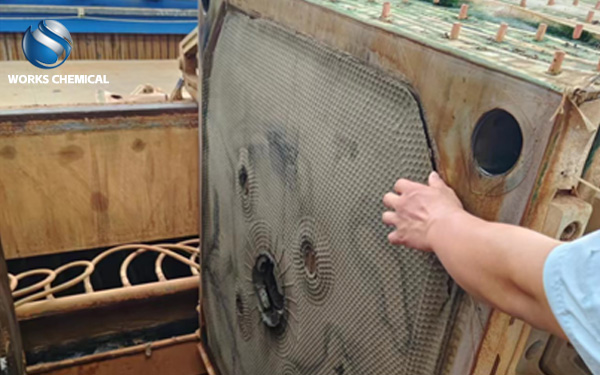
Common reasons for the sludge pressed by the filter press not being dry and sticking to the filter cloth
Equipment factors
Youdaoplaceholder0 Filter cloth problem : Incorrect selection of filter cloth, poor filtration performance, or incomplete cleaning and clogging of the filter cloth will all cause the filtration channel to become smaller or even clogged, resulting in poor water flow and difficulty in obtaining dry filter cake. For instance, the filter cloth used in a certain sewage treatment plant has insufficient fiber density. When treating sludge, the sludge particles are prone to clogging the filter cloth, resulting in the moisture content of the dewatered sludge cake being over 85%, and the phenomenon of clogging the filter cloth occurs frequently.
Youdaoplaceholder0 Feed pump failure : A feed pump failure can lead to insufficient feed pressure and a slower dewatering speed. Data shows that when the feed pressure is 30% lower than the normal value, the dewatering efficiency of the filter press will decrease by about 50%, and the moisture content of the mud cake will also increase significantly.
Youdaoplaceholder0 Short squeezing time : Insufficient squeezing time prevents the water in the sludge from being fully squeezed out. Experimental data shows that under the same conditions, when the extrusion time is shortened from 10 minutes to 5 minutes, the moisture content of the mud cake will rise from 70% to over 80%.
Pharmaceutical factors
Youdaoplaceholder0 Incorrect selection of chemicals : Different types of filter presses should be treated with different chemicals. Plate and frame filter presses are suitable for using inorganic flocculants and low-molecular-weight flocculants. Belt filter presses are more suitable for choosing products with medium molecular weights. Centrifuges tend to use products with high molecular weight. If the wrong type is selected, the coagulation and flocculation effect of the sludge will be poor, which will lead to difficulties in dewatering. For instance, a certain factory used high-molecular-weight flocculants on the plate and frame filter press. As a result, the sludge became sticky and adhered to the filter cloth, clogging it and preventing the dewatering process from proceeding normally.
Youdaoplaceholder0 Improper dosage of chemicals : Insufficient dosage of chemicals, poor sludge flocculation effect, and high moisture content; However, if too much is added, it will cause the sludge to become sticky, stick to the filter cloth or clog it. Experiments have shown that when the dosage of the reagent is less than 20% of the optimal dosage, the moisture content of the mud cake will increase by 10% to 15%. When the dosage exceeds 30% of the optimal dosage, the sludge will become sticky and the clogging rate of the filter cloth will reach over 50%.
Factors of sludge properties
If the sludge is too fine, too sticky or has an excessively high organic matter content, it will make it difficult for surface and interstitial water to be removed. For instance, in some chemical sludges, the proportion of particles with diameters less than 0.1mm exceeds 70%, and the organic matter content is as high as over 60%. During the filtration process of such sludges, water is difficult to be squeezed out, and the moisture content of the sludge cake is often above 80%, and it is prone to adhering to the filter cloth.
The working principle and effect of sludge enhancers
Principle of operation
Sludge enhancer is a kind of chemical agent that can change the surface structure of sludge, reduce the solid surface load of sludge, lower the specific surface area of sludge, and destroy the structure of bacteria. It contains components such as water purifying agents, organic polymers, sludge stripping agents, sludge surface treatment agents, cell wall breakers, degreasing agents, and sludge surface structure modifiers. These components, through synergistic action, alter the surface properties of sludge, reduce its specific surface area, disrupt cell walls and cell membranes, release intracellular water, remove free water, bound water, capillary water and most of the intracellular water in biochemical sludge cells, thereby enhancing the permeability of sludge.
Effect display
Youdaoplaceholder0 Reduce moisture content : Multiple practical application data show that after using the sludge enhancer, the moisture content of the sludge cake can be significantly reduced. For instance, before a certain sewage treatment plant started using sludge enhancers, the average moisture content of the sludge cake was 82%. After the application, it dropped to around 65%, a reduction of 17 percentage points.
Youdaoplaceholder0 Solving the problem of sticky filter cloth : Components such as sludge stripping agent in the sludge enhancer can effectively prevent sludge from adhering to the filter cloth. After the sludge enhancer was used in the filter press of a certain printing and dyeing factory, the clogging rate of the filter cloth was reduced from 3 to 4 times per month to less than once per month, which greatly improved the utilization efficiency and dewatering effect of the equipment.
Youdaoplaceholder0 Improve dewatering efficiency : Due to the enhanced permeability of sludge, the dewatering speed is accelerated. Experiments have shown that after using sludge enhancers, the dewatering time of the filter press has been shortened by an average of about 30%, improving production efficiency.
The sludge enhancer can effectively solve the problems of the sludge not being dried and sticking to the filter cloth in the filter press. It enhances the dewatering efficiency and effect of the filter press by improving the properties of the sludge, increasing its permeability, reducing the moisture content of the sludge cake, and preventing the sludge from adhering to the filter cloth. In practical applications, sludge enhancers should be reasonably selected and used based on the nature of the sludge and the type of filter press to achieve the best dewatering effect.