

In the field of sewage treatment and sludge disposal, plate and frame filter presses occupy a core position due to their highly efficient dewatering performance, but their dewatering effect is highly dependent on the sludge conditioning process before feeding. Due to problems such as large dosage, corrosion of equipment and clogging of filter cloth, traditional chemicals are gradually being replaced by new sludge enhancers. This article, combining industry practice and technological innovation, analyzes how sludge enhancers can break through traditional limitations and become the preferred solution for plate and frame dewatering.
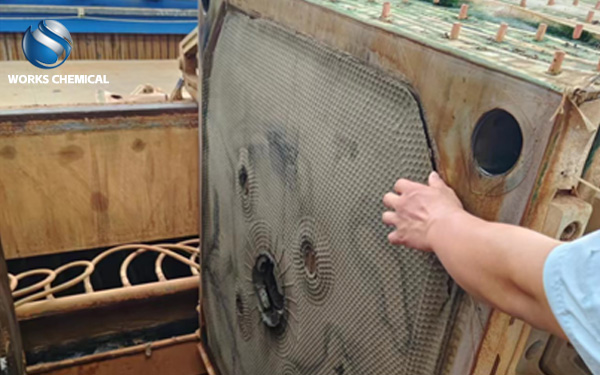
The limitations of traditional pharmaceuticals: The dual challenges of cost and efficiency
Traditional sludge conditioning mainly relies on inorganic salts (such as lime, iron salts, and aluminum salts) and organic flocculants (such as PAM), but it has significant drawbacks:
Large dosage and high cost: Inorganic salts need to be added at 10% to 30% of the dry basis weight of the sludge, which leads to sludge volume expansion and a sharp increase in subsequent treatment costs.
Equipment corrosion and filter cloth clogging: Chemicals with high chloride ion content will accelerate the rusting of metal equipment and increase the frequency of filter cloth replacement.
Limited dewatering effect: Conventional agents can only reduce the moisture content of sludge to 70%-80%, which is difficult to meet the requirements of deep dewatering.
A certain municipal sewage treatment plant once adopted a combination of "lime +PAM", which achieved initial dewatering. However, the moisture content of the sludge cake remained around 75% for a long time, and the filter cloth needed to be replaced on average every three days, with an annual maintenance cost exceeding one million yuan.
Sludge efficiency enhancer: Technological innovation solves industry pain points
The sludge efficiency enhancer modifies the sludge structure at the microscopic level through the synergistic effect of multiple components. Its core advantages are reflected in the following aspects:
Deep dehydration leads to a direct reduction of 40% to 60% in water content
The sludge efficiency enhancer contains ** and ** agents, which can break down the cell walls of microorganisms in sludge, release bound water, and reduce the specific surface area of sludge through surface modifiers, thereby reducing water adsorption. In the application of the sludge enhancer in a certain printing and dyeing factory, the sludge with a moisture content of 92% was reduced to 55%, and the volume of the mud cake was decreased by 60%, achieving the goal of reduction.
The dosage is reduced by 50%, and the cost is directly lowered by 30%
The sludge enhancer adopts the "targeted conditioning" technology, and only 0.2%-0.5% of the dry basis weight of the sludge is needed to achieve the ideal effect. A comparative experiment conducted by a certain paper mill shows that after using the sludge efficiency enhancer, the cost of the agent dropped from 80 yuan per ton of sludge to 55 yuan. At the same time, the lime addition step was eliminated, and the overall cost decreased by 32%.
3. The equipment is user-friendly and its operational stability has been enhanced
The sludge enhancer does not contain chloride ions, thus avoiding metal corrosion. The flocs formed are loose and porous in structure, with excellent water permeability, and the clogging cycle of the filter cloth is extended to more than 15 days. After the application of the sludge treatment project in a certain chemical industrial park, the pressing pressure of the plate and frame filter press was reduced from 1.2MPa to 0.8MPa, and the service life of the equipment was extended by two times.
4. Full-process compatibility facilitates resource utilization
The calorific value of the sludge treated with the sludge efficiency enhancer increases by 15% to 20%, and it can be directly incinerated for power generation. The strength of the mud cake has increased, meeting the requirements of resource utilization processes such as brick-making and composting. A certain domestic sewage treatment plant has achieved a closed loop of sludge "reduction - stabilization - resource utilization" through sludge efficiency enhancers, reducing the annual transportation of sludge by 12,000 tons and saving 2.4 million yuan in disposal costs.
Conclusion
The efficiency and cost of plate and frame sludge dewatering mainly depend on the selection of chemicals. Sludge enhancers, with their comprehensive advantages such as deep dewatering, cost optimization, and equipment friendliness, are reshaping industry technical standards. Enterprises need to combine the characteristics of their own sludge and process requirements, scientifically select models and precisely implement policies in order to achieve a win-win situation between environmental compliance and economic benefits.