

During the sludge dewatering process, plate and frame filter presses are widely used due to their high efficiency and stability. However, many operating units often encounter the problem of excessively high moisture content in the sludge cake, which not only increases the subsequent processing costs but also may affect the environmental protection compliance. The reasons for this include not only factors such as equipment parameters and operation processes, but also the improper selection of chemicals, which is often the key issue.
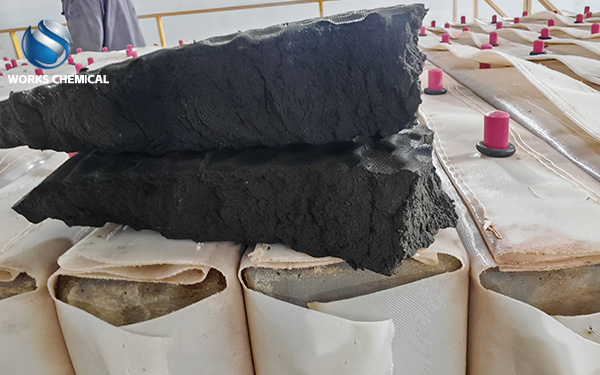
1. The main reason for high moisture content is that the selected reagents do not match.
Although traditional inorganic coagulants (such as polyaluminium chloride PAC) have low costs, their effect on sludge conditioning is limited, and they are prone to causing loose filter cakes with high moisture content.
If the molecular weight or ionic degree of organic polymer flocculants (such as polyacrylamide PAM) is improperly selected, it may cause the sludge to adhere to the filter cloth, thereby reducing the dewatering efficiency.
Changes in sludge characteristics
The sources and compositions of sludge are complex (such as municipal sludge, industrial sludge, etc.). If the reagents are not adjusted dynamically according to the characteristics of the sludge, the dewatering effect will fluctuate.
The addition parameters were not optimized.
The dosage of the reagent, mixing time, etc. were not optimized according to the actual working conditions, which affected the flocculation effect of the sludge.
II. Optimization Direction of Chemicals
In response to the aforementioned issues, it is recommended to start with the selection of chemicals, choosing the "Composite Sludge Enhancer". This type of chemical enhances the dewatering effect through the following mechanisms:
Synergistic effect: By combining the advantages of inorganic coagulants and organic flocculants, it improves the structure of the sludge flocs and enhances the compactness of the filter cake.
Wide adaptability: The formula can be flexibly adjusted according to the characteristics of the sludge, and it is suitable for various types of sludge such as municipal, papermaking, and dyeing.
Eco-friendly and environmentally friendly: Reduce the total dosage of chemicals, lower operating costs, and simultaneously minimize the risk of secondary pollution.
III. The Application Value of Sludge Enhancing Agents
In recent years, the composite type agents such as sludge enhancing agents have performed exceptionally well in multiple projects. Their technical advantages include:
Significantly reduce moisture content: By optimizing the structure of the flocs, the moisture content of the sludge cake can be reduced to below 60%.
Reduce filter cloth adhesion: The unique formula design avoids the problem of sludge adhering to the filter cloth, thereby extending the equipment's lifespan.
Pilot Testing: It is recommended to conduct a small-scale trial before actual application, and precisely adjust the dosage parameters based on the characteristics of the sludge.
The solution to the problem of moisture content in plate-and-frame dehydration requires comprehensive consideration of equipment, process, and reagent selection. By scientifically matching efficient sludge enhancers, not only can the dehydration efficiency be improved, but also a win-win situation of economic benefits and environmental benefits can be achieved. In practical applications, it is recommended to combine professional guidance and gradually optimize the reagent scheme.