

With the increasingly strict environmental requirements and the continuous development of sludge treatment technologies, sludge dewatering has become a crucial step in wastewater treatment plants and industrial wastewater treatment. Plate and frame filter presses, as a common sludge dewatering equipment, are widely used due to their efficient solid-liquid separation capabilities. However, the traditional plate and frame dewatering process often encounters problems such as low dewatering efficiency and high filter cake moisture content when dealing with sludge with high moisture content or high viscosity. The introduction of sludge enhancers has significantly improved the efficiency and effect of plate and frame sludge dewatering, becoming an important technical means to solve this problem.
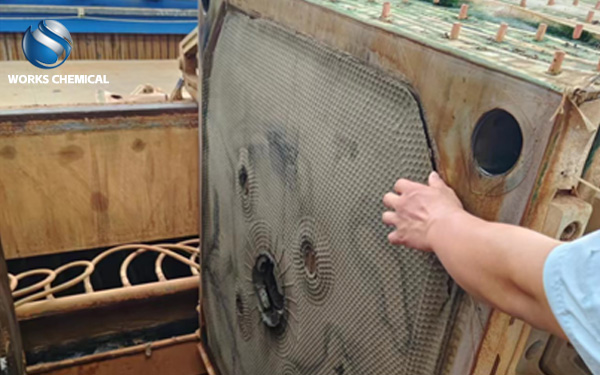
The mechanism of action of sludge enhancer
The sludge enhancer is a chemical agent specifically designed to improve the dewatering performance of sludge. Its main functions include:
Flocculation: Through the processes of charge neutralization and adsorption bridging, the sludge particles form larger flocs, facilitating the subsequent solid-liquid separation.
Improving the structure of the filter cake: Optimizing the distribution of sludge particles, reducing the compressibility of the filter cake, increasing the porosity of the filter cake, thereby lowering the moisture content of the filter cake.
Reduce viscosity: Decrease the viscosity of the sludge to prevent filter cloth from getting clogged and extend the service life of the equipment.
Application of Sludge Enhancer in Plate-and-Frame Sludge Dewatering
Municipal Sludge Treatment:
Municipal sludge usually has a high moisture content and is highly viscous. Direct use of plate and frame filter presses for dehydration does not yield satisfactory results. After adding sludge enhancers, the dehydration performance of the sludge is significantly improved, and the moisture content of the filter cake can be reduced to below 60%.
Industrial Sludge Treatment:
Industrial sludge (such as from papermaking, dyeing, and chemical industries) has complex components and is difficult to dehydrate. Sludge enhancers can be adjusted according to different sludge characteristics to achieve efficient dehydration.
Advantages of sludge enhancer
High efficiency: Significantly reduces the moisture content of the filter cake and improves the dewatering efficiency.
Broad adaptability: Suitable for various types of sludge, including municipal sludge and industrial sludge.
Economy: Reduces filter cloth wear and energy consumption, lowers operating costs.
Environmental friendliness: No secondary pollution, in line with environmental protection requirements.
The wide application of sludge enhancers in plate-and-frame sludge dewatering not only solves the bottleneck problems of traditional dewatering processes, but also improves the operational efficiency and economic benefits of the equipment. With the continuous advancement of technology, sludge enhancers will play a more significant role in the field of sludge treatment, providing strong support for achieving sludge reduction, resource utilization, and harmless treatment.