

In today's increasingly strict environmental protection industry, "deep sludge dehydration" has become the focus of attention for wastewater treatment plants and industrial enterprises. Many customers often ask: "Can the moisture content of the sludge cake be directly reduced to 40% after using your reagents?" In response to this, the technical team of Works Co., Ltd. hopes to provide an objective and scientific answer: Sludge dehydration is a systematic project, and the reagents are a key factor, but not the only determining factor.
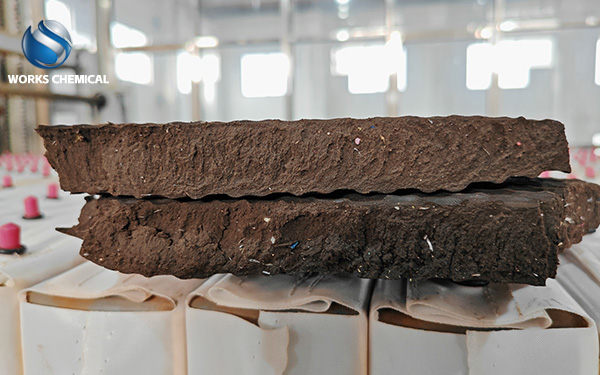
The traditional sludge moisture content is usually between 90% and 99%, and it is bulky, making transportation and disposal extremely costly. By adding sludge enhancers (such as the SJC series modified polymers developed by our company), it is indeed possible to effectively disrupt the sludge's colloidal structure and release bound water, thereby significantly reducing the moisture content. In a well-functioning belt press filtration process, with a reasonable dosage of chemicals, it is generally achievable to reduce the moisture content to below 60%; under specific conditions and through optimization, some projects can achieve a moisture content of 50% to 55%.
However, it must be emphasized that the final dehydration effect is influenced by multiple factors:
1. Differences in sludge properties: The organic matter content, viscosity, and composition of municipal sludge, dyeing sludge, and papermaking sludge vary, and there are differences in their sensitivity to reagents.
2. Equipment conditions: The pressure level of the filter press, the filtration cycle, and the permeability of the filter cloth, among other hardware parameters, directly limit the physical dehydration capacity.
3. Operating parameters: Details such as pH value adjustment, stirring intensity, and reaction time are equally crucial.
Works Co., Ltd. advocates "one factory, one strategy". We do not guarantee that all scenarios can reach the theoretical minimum value. Instead, through pilot tests and pilot-scale trials, based on the actual data from the customer's site, we formulate the most economical and stable dosage plan for the chemicals. Our goal is to help customers achieve repeatable and sustainable reduction effects under the existing equipment conditions, rather than pursuing uncontrollable extreme data.