

Why does sludge stick to the fabric? The technical experts from Works Chemical Company analyzed and pointed out that this is mainly related to the nature of the sludge and the conditioning method. Municipal sludge and some industrial sludge contain a large amount of extracellular polymers and colloidal substances, which have extremely strong hydrophilicity and stickiness. Traditional inorganic salt conditioning (such as lime and iron salts) can remove some moisture through precipitation, but they cannot fundamentally change the adhesion characteristics of the sludge colloids. Sometimes, due to the drastic change in pH value, the sludge properties become even more viscous.
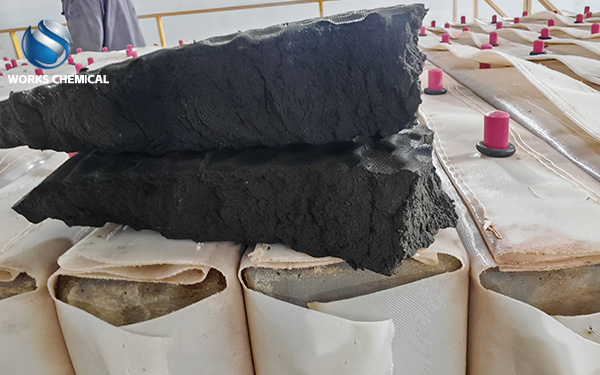
To address this challenge, the R&D team of Works Chemical took an alternative approach and successfully developed a new type of sludge dewatering agent (sludge enhancer). This agent is a modified organic polymer with special hydrophobic groups on its molecular chain. During the conditioning process, these hydrophobic groups will be arranged directionally on the surface of the sludge flocs, forming a microscopic "separation membrane". This membrane not only prevents the combination of water and sludge particles, but more importantly, it significantly reduces the friction coefficient and adhesion force between the sludge cake and the filter cloth.
In practical application cases, a dyeing factory had been using traditional chemicals for a long time, with the frequency of filter cloth cleaning reaching once a week, and the sludge cake detachment rate being less than 60%. After introducing the sludge enhancement agent from Works Chemical, the situation underwent a fundamental transformation. According to on-site feedback, the edges of the filter cake after pressing are clear, and the surface is dry. During the pulling process, the sludge cake can naturally detach by its own gravity, with the detachment rate reaching over 95%. Workers vividly described it as: "Before it was like scooping chewing gum, now it's as easy as pouring sand."
In addition to its remarkable dehydrating effect, this sludge enhancer from Works Chemical also has a deep dehydrating function. Due to its unique molecular structure, it can convert the capillary-bound water in the sludge into free water, further reducing the moisture content of the sludge cake. For enterprises, choosing Works Chemical's sludge enhancer means not only solving the problems of labor shortage and equipment maintenance difficulties, but also achieving a dual improvement in dehydrating efficiency and economic benefits.