

On the production line for deep sludge dewatering, the plate and frame filter press serves as the core processing equipment, bearing the crucial mission of reducing and harmlessizing sludge. Its operational efficiency directly determines the production rhythm and operating costs of the sewage treatment enterprises. However, the "sticky cloth" problem, like a "cancer" attached to the plate and frame filter press, has long plagued industry practitioners and has become a prominent pain point that hinders the efficient advancement of production, leaving countless sewage treatment enterprises at a loss.
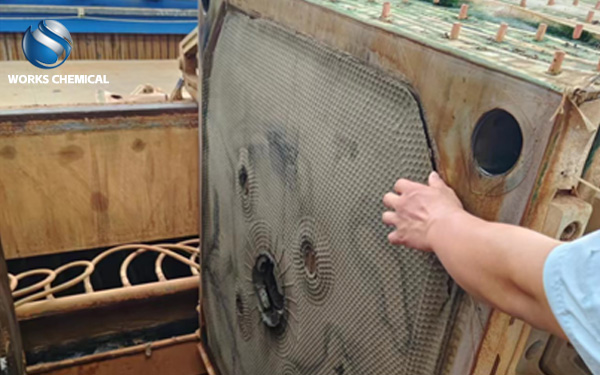
Anyone familiar with the sludge treatment process knows that the normal operation of the belt press filter depends on the orderly cycle of the filtration process. Only when each cycle is smoothly connected can the sludge dewatering work continue. However, in actual production, whenever the filtration cycle ends, the sludge cake that should simply and neatly detach from the filter cloth often adheres stubbornly to the surface of the filter cloth, making it difficult to fall off. To avoid affecting the next round of production, workers have to hold shovels and scrape off the remaining sludge cake with great effort. This not only involves extremely high labor intensity, consumes a lot of manpower and time, but also causes a headache because the repeated scraping with the shovels is very likely to damage the filter hole structure on the filter cloth surface, shortening the service life of the filter cloth and increasing the cost of consumables replacement for the enterprise.
The harm caused by "sticky cloth" goes far beyond this. The remaining sludge cake will firmly block the pores of the filter cloth, resulting in obstruction and reduced flow rate of the sludge feed during the next stage of pressure filtration. This not only significantly prolongs the filtration cycle and reduces production efficiency, but in severe cases, it may also cause slurry spraying. Once slurry spraying occurs, it will not only lead to sludge leakage and pollution of the production environment, but also force the entire production process to be suspended, requiring comprehensive cleaning and maintenance, causing unnecessary economic losses and production delays for the enterprise, and becoming a "roadblock" that hinders the high-quality development of many wastewater treatment enterprises.
For a long time, numerous enterprises in the industry have tried various solutions, such as adjusting the pressure filtration parameters, replacing the filter cloth material, or increasing the frequency of manual cleaning. However, none of these measures could fundamentally solve the "stuck filter cloth" problem. They could only respond passively and bear multiple losses in terms of manpower, resources, and finances. Just as the industry was facing this predicament as a whole, Works Chemical Co., Ltd. delved into the field of sludge treatment, focused on the production pain points at the front line, and developed a new type of sludge enhancer. This has brought a breakthrough solution to the "stuck filter cloth" problem, completely breaking through this industry bottleneck.
This new type of sludge enhancer, with its unique formula and advanced technology, can precisely improve the dewatering performance of sludge, optimize the structure of sludge flocs, and reduce the adhesion between sludge and filter cloth. In practical applications, simply adding it reasonably before the filter press operation can make the filter cake after filtration loose in texture, have moderate toughness, and automatically fall off, completely eliminating the occurrence of "sticking to the filter cloth" phenomenon. This breakthrough not only completely liberates manual labor, significantly reduces the labor intensity of workers, avoids damage to the filter cloth due to manual cleaning, effectively extends the service life of the filter cloth, and reduces the cost of consumables; it also solves the problem of filter cloth pore blockage, ensures smooth connection of the filter press cycle, eliminates the risk of slurry spraying, and significantly improves the production efficiency of sludge dewatering.
By fundamentally addressing the stubborn problem of the "sticky cloth" industry, Works Chemical's sludge enhancer not only brings great convenience to the production and operation of wastewater treatment enterprises, but also helps them reduce operating costs and improve production efficiency. It injects new impetus into the high-quality development of the deep sludge dehydration industry and has become the preferred solution for many wastewater treatment enterprises.