

The high moisture content of the sludge cake and the presence of a soft core inside are the most challenging environmental problems in plate-and-frame sludge dewatering, directly restricting the reduction and resource utilization of sludge. The sludge has a stable colloid, and extracellular polymers (EPS) form a hydrophilic protective layer, firmly locking the bound water and capillary water. Traditional PAC, iron salts, and lime can only neutralize the surface charges of the particles, but they cannot destroy the EPS network structure and the microbial cell walls, making it difficult to remove the internal bound water. During the high-pressure pressing process, the pores of loose inorganic flocs close rapidly, and the water is retained in the center of the sludge cake, forming an outer layer that is slightly dry and an inner layer that is soft and loose, resulting in a sludge cake with a soft core.
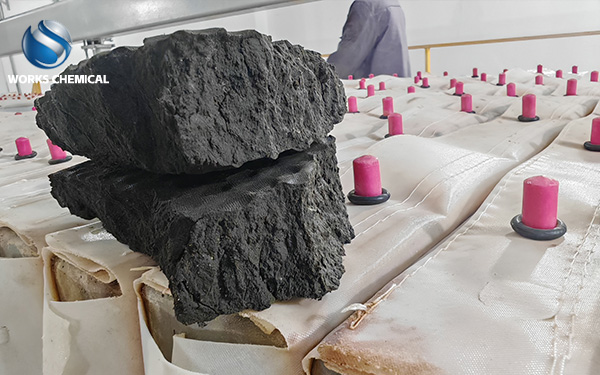
The high-moisture sludge cake has a large volume, and the cost of its external transportation and disposal doubles. The soft and unstable sludge is prone to leakage, which can easily cause road pollution during transportation and lead to environmental penalties. When disposed of by incineration, the high moisture content sludge has extremely low calorific value, requiring additional fuel to be added, resulting in a significant decrease in resource utilization benefits. Even if the pressing time is extended and the equipment pressure is increased, the problem of water retention cannot be fundamentally solved. Instead, it increases energy consumption and filter cloth wear.
The triple synergy technology of sludge enhancer directly targets the root cause of water retention: The first step is highly efficient cell disruption, which breaks down the hydrophilic structure of EPS and opens up the microbial cells, releasing the internal bound water; the second step is powerful flocculation, which forms dense and hydrophobic flocs, reducing capillary water absorption; the third step is channel optimization, with water channels reserved within the flocs, allowing the moisture to be uniformly discharged during the pressing stage, completely eliminating the phenomenon of soft core and significantly reducing the moisture content of the sludge cake, while maintaining a stable decrease in moisture level.
Compared with traditional inorganic conditioning processes, this product can remove the vast majority of bound water from the sludge. The moisture content inside and outside the sludge cake is uniform, meeting the environmental protection standards for landfill and incineration. The organic matter in the sludge cake is completely retained, resulting in higher incineration calorific value and significantly enhanced value for resource utilization. The manufacturer provides free small-scale trial of the agent, customizing the agent formula based on the sludge's fiber and organic matter content, and providing long-term after-sales tracking to ensure a stable sludge cake quality and avoid environmental risks in sludge disposal.