

The sludge specific resistance is a key technical indicator for measuring the difficulty of dewatering. The higher the specific resistance value, the more difficult it is for water to pass through the sludge layer, and the lower the efficiency of plate and frame filter press. Traditional combinations of iron salts, lime, and PAC can only achieve simple flocculation and cannot change the internal pore structure of the sludge. The reduction in sludge specific resistance after treatment is limited, and the water penetration is slow under high-pressure pressing, resulting in a prolonged filter press cycle and difficulty in exerting the energy efficiency of the equipment.
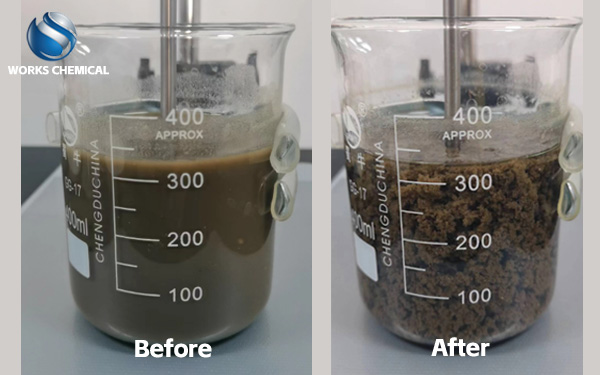
The fine particles and colloidal substances within the sludge will gradually compress each other, thereby compacting the filter layer and reducing the water-permeable pores. This is the core reason why the dewatering process almost stops in the later stage of pressure filtration. To enhance the capacity of plate and frame treatment, the key lies in reducing the specific resistance of the sludge at its source and constructing a long-lasting water-permeable structure.
The sludge enhancer relies on high-molecular modification technology to optimize the structure of the sludge filter layer at the microscopic level. The reagent first breaks the water-retaining structure of extracellular polymers, releasing the bound water. Then, through the high-molecular chain, it aggregates the tiny particles into regular flocs, while introducing rigid skeleton components to ensure that the sludge layer retains uniform and continuous water-permeable pores. After conditioning, the specific resistance of the sludge significantly decreases, and the moisture can quickly penetrate the filter layer under pressure. The permeation efficiency during the pressure filtration process remains at a high level throughout the entire process.
Compared with traditional processes, after using the sludge enhancer, not only does the single batch filtration time significantly shorten, but the effective utilization rate of the filter press also increases significantly. Moreover, it can reduce the long-term pressure load on the filter cloth and delay the aging of the filter cloth. This technology has a clear principle and is easy to implement, and is suitable for various high-pressure filter press equipment. By precisely controlling the dosage based on the actual site conditions, it can continuously optimize the sludge specific resistance. Without increasing the investment in equipment, it can achieve a qualitative improvement in the filtration efficiency of the filter press, making it a high-quality choice for process upgrading.