

In the frontline of industrial and municipal sludge treatment, many enterprises have long been plagued by a series of problems such as "clumpy sludge cake, high moisture content, and high disposal costs". When faced with these challenges, many factories' first reaction is often to blindly increase the dosage of traditional chemicals or frequently replace the filter cloth. However, this not only fails to solve the problems but also leads to a sharp increase in operating costs. In fact, up to 90% of the problems related to sludge dewatering stem from the enterprises' mistakes in selecting the conditioning agents and matching the processes.
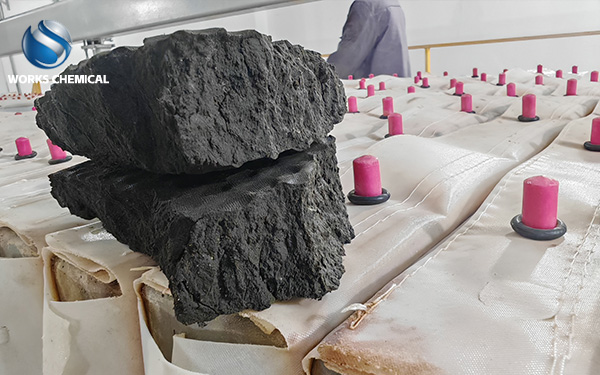
The limitations of traditional inorganic conditioning agents (such as lime, iron salts, etc.) are the main culprits causing this predicament. These agents not only require large dosages, resulting in a significant increase in sludge volume, but their strong hydrophilicity also causes fine particles to firmly adhere to the micropores of the filter cloth, making discharge difficult and increasing the cost of manual flushing. Even more fatal is that traditional agents can only act on the surface of the particles and cannot destroy the extracellular polymers (EPS) inside the sludge, with the water being tightly locked, easily forming a "dry on the outside, watery on the inside" sludge cake under high-pressure pressing, directly increasing the transportation and disposal costs.
In response to this industry selection error, Works Chemical, leveraging its nearly ten years of frontline industry experience, has precisely developed a sludge enhancer. This is a multifunctional modified polymer specially designed for the plate and frame filtration process. It reshapes the dehydration logic at the molecular structure level. It does not rely on a large amount of inorganic salts for weight gain and can precisely act on the sludge colloids, completely breaking down the cell walls and gels, and fully releasing the internal bound water. During the filtration process, the sludge enhancer can effectively clear the water channels, resulting in a thicker sludge cake with uniform internal and external dryness, and achieving natural detachment, completely eliminating the problem of sticky cloth.
Incorrect selection leads to wasted efforts. The upgrade from traditional inorganic salts to high-molecular modified polymers is not only a technological leap but also the inevitable path for enterprises to reduce costs and increase efficiency. The Works Chemical team provides a full-process service from free on-site sampling, laboratory selection tests to the issuance of exclusive solutions, helping enterprises avoid the pitfalls of selection. Choosing sludge enhancers enables the sludge to reach the desired consistency and ensures smooth operation of the equipment, truly transforming sludge treatment from a "cost black hole" into a "beneficial link".