

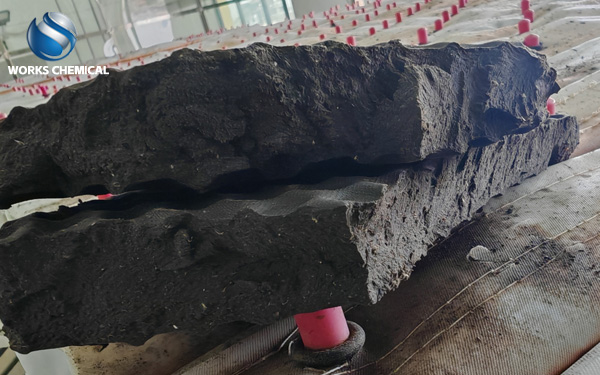
How to solve the "sticky and soggy" problems of plate and frame filter presses? Choosing the right dehydration agent is key On the front lines of industrial and municipal sludge treatment, plate and frame filter presses often encounter two major problems: "sticky filter cloth" and "soggy interior (dry on the outside and wet on the inside)" of the sludge cake. This not only makes the discharge difficult and increases the cost of manual cleaning, but also keeps the moisture content of the sludge cake high, significantly increasing the transportation and disposal costs. Many enterprises attribute the problem to insufficient equipment pressure or improper selection of filter cloth, but they overlook the most crucial pre-factor - the selection of dehydration agents and the adjustment process.
The core function of the dehydration agent: breaking down the cell wall and reshaping the flocs
The reason why sludge is difficult to be dehydrated lies in the fact that its surface is rich in a large number of hydrophilic groups, and the extracellular polymers (EPS) secreted by microorganisms firmly lock the water inside the cells. Traditional inorganic conditioning agents (such as lime, iron salts) can only neutralize the surface charge but cannot break the cell wall, resulting in the water still remaining in the center of the sludge cake under high pressure, forming a "soft core".
High-quality sludge dewatering agents can play an irreplaceable core role. Through polymer composite technology, they precisely act on the sludge colloids, completely disintegrate the cell walls and gels, and convert bound water into free water. At the same time, the agents can optimize the structure of the flocs, making them have sufficient rigidity and water filtration properties, thus forming thick and uniformly dry inner and outer layers of dense sludge cakes during plate and frame filtration.
Analysis of secondary causes: Chain reaction between agent selection and operation
Apart from the mechanism of the agent itself, the following several secondary reasons are also common causes leading to the failure of sludge pressing:
Inbalance in the dosage of the agent: Insufficient dosage will result in the formation of loose and fine flocs that cannot effectively retain water; while excessive dosage will cause the sludge to become overly sticky, not only preventing water from being discharged but also tightly adhering to the filter cloth pores, causing severe blockage.
Insufficient mixed reaction: If the mixing time of the reagent and the sludge is insufficient or the mixing method is improper, it will result in an uneven reaction. Usually, a rapid dispersion is required before transitioning to low-speed flocculation to allow the flocs to grow steadily, otherwise it is difficult to form flocs that are easy to be dehydrated.
Mud quality and environmental fluctuations: Changes in the content of oils and organic substances in the sludge, or the low-temperature conditions in winter, will increase the viscosity and hydrophilicity of the sludge. If the type of reagent is not adjusted in time or the reaction time is prolonged due to changes in mud quality, it is very likely to cause a sharp decline in the dewatering effect.
In conclusion, to solve the "stickiness and slippage" problems of plate and frame filter presses, the focus must be placed on the precise selection and scientific application of dehydration agents. Only by improving the sludge's dehydration performance at the source can the smooth operation of the equipment and the cost reduction and efficiency improvement of the enterprise be truly achieved.